Know Why IBBI Proposed Safeguards for Personal Guarantors After Subhash Chandra Case
 Copy Link
 Share
Share Save
Save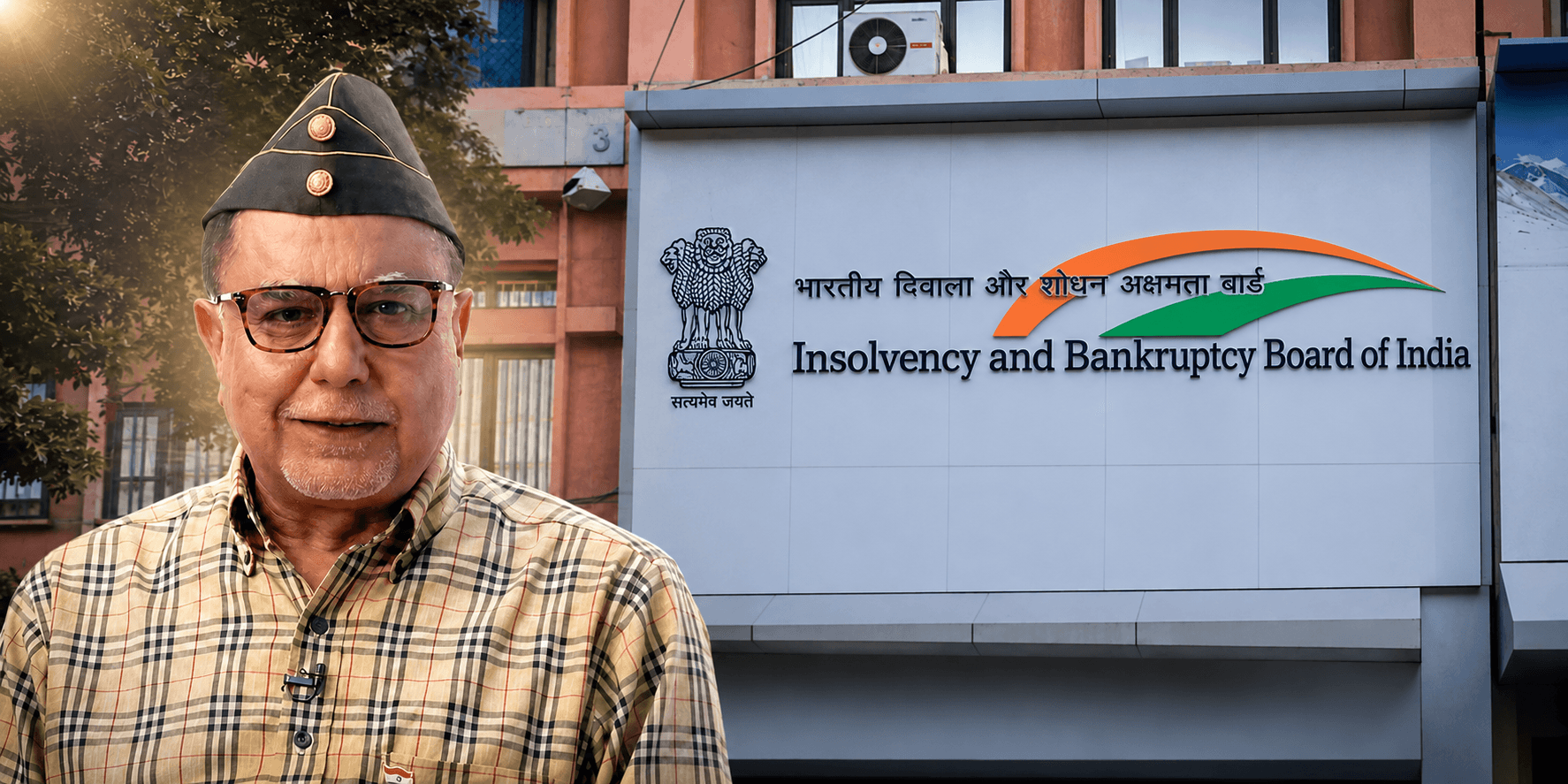
The Insolvency and Bankruptcy Board of India (IBBI) has issued a Discussion Paper proposing four amendments to the Insolvency and Bankruptcy (Application to Adjudicating Authority for Insolvency Resolution Process for Personal Guarantors to Corporate Debtors) Rules, 2019 (IRP Rules), read with the Insolvency and Bankruptcy Board of India (Insolvency Resolution Process for Personal Guarantors to Corporate Debtors) Regulations, 2019 (IRP Regulations). The last date for submission of public comments on the Discussion Paper is 3rd October, 2026.
Several reports suggest that the action plan by IBBI has some aftermath pertaining to what happened recently in the Subhash Chandra case. Hence, let us scan through the Subhash Chandra case at NCLT to understand what the IBBI suggests as safeguards strengthening the position of personal guarantors.
Background: The Subhash Chandra Repayment Plan
Essel Group founder Subhash Chandra had furnished personal guarantees for loans raised by Essel Group companies. Personal insolvency proceedings were initiated against him under the Code in connection with these guarantees. On 25th August 2026, a member of the National Company Law Tribunal (NCLT) approved a repayment plan in Chandra's personal guarantor insolvency resolution process, after an earlier two-member bench had differed on the plan and the matter was referred to a third member.
Under the approved plan, creditors with admitted claims of approximately ₹22,006.57 crore were to receive around ₹6.25 crore, with a further ₹25 lakh earmarked towards insolvency process costs. The plan had secured 80.81 per cent support in voting among creditors, though several lenders including HDFC Bank, Axis Bank, Canara Bank, RBL Bank and Union Bank of India, voted against it. Dissenting lenders subsequently questioned the participation of certain entities in the voting process, alleging that entities such as Veena Investments, Direct Media Distribution Ventures, World Crest Advisors, Lemonade Capital Advisors and Corpcall Capital Advisors were connected to Chandra or his family and had voted in a manner that helped the plan cross the required threshold. LIC Housing Finance separately raised the absence of a forensic audit of Chandra's financial position, stating that it stood to recover about ₹38 lakh against an admitted claim of roughly ₹1,322 crore under the plan.
Stay on Subhash Chandra's Repayment Plan
Dissenting creditors, including LIC Housing Finance, Canara Bank and Union Bank, filed an appeal before the National Company Law Appellate Tribunal (NCLAT) challenging the NCLT's approval of the repayment plan. Before this appeal could be heard on merits, a newly constituted five-member Special Bench of the NCLT stayed its own 25th August order approving the plan and decided to examine the matter afresh, with a hearing scheduled for 23rd September 2026.
When the matter came up before the NCLAT, Solicitor General Tushar Mehta, appearing for the dissenting creditors, informed the appellate tribunal of this stay. Counsel for Chandra objected to the appeal being disposed of, submitting that the proceedings had caused reputational damage to his client. Following this objection, the request to dispose of the appeal was not pressed, and the NCLAT instead kept the appeal pending, adjourning it for further hearing on 7th October 2026. As things stand, the 25th August order approving the repayment plan is stayed and is to be reconsidered by the five-member NCLT bench.
Why IBBI Says the Personal Guarantor Framework Needs Strengthening
According to the Discussion Paper, a review of the framework governing insolvency resolution of personal guarantors, alongside the framework for corporate insolvency resolution process (CIRP) under the IBBI (Insolvency Resolution Process for Corporate Persons) Regulations, 2016 (CIRP Regulations), showed four respects in which safeguards available to creditors of a corporate debtor under CIRP have no counterpart in the personal guarantor process, even though the Paper states that the underlying concern is identical regardless of whether the debtor is a company or an individual.
Proposal 1: Related Parties Should Not Vote on the Repayment Plan
The IBBI Paper notes that under CIRP, a "related party" of the corporate debtor has no right to vote in the committee of creditors, but under the personal guarantor process, only an "associate" of the guarantor is barred from voting. As an illustration, the Paper states that a company that habitually acts on the guarantor's advice or instructions, without the guarantor holding shares in it or controlling its board, would qualify as a "related party" but would fall outside the definition of "associate," and could therefore vote on a repayment plan even though that very plan determines the extent of the guarantor's discharge from debt.
IBBI has proposed that a related party of the guarantor, as defined in section 5(24A) of the Code, be assigned a "Nil" voting share, and that the list of creditors separately indicate whether a creditor is a related party of the guarantor. This would be achieved by amendments to regulation 9(1) and regulation 11(2) of the IRP Regulations.
Proposal 2: Reporting of Avoidance Transactions Before the Vote
The Paper states that sections 164, 165 and 167 of the Code allow a bankruptcy trustee to seek orders regarding avoidance transactions: undervalued transactions, transactions giving preference, and extortionate credit transactions, but only at the bankruptcy stage, which follows the resolution process. During the resolution process itself, when the repayment plan is formulated and voted upon, the resolution professional presently has no obligation to examine whether such a transaction has taken place, even though this bears on the value available to creditors and on whether the guarantor has made honest disclosure.
By contrast, the Paper notes, CIRP Regulations require the resolution professional to place before the committee of creditors details of any preferential, undervalued, extortionate credit or fraudulent transactions observed, before a resolution plan is voted on. IBBI has proposed inserting a new regulation 10A requiring the resolution professional to examine and record whether the guarantor has been party to such a transaction, and to place these findings before the creditors' meeting prior to the vote. The resolution professional would also be enabled, with creditors' approval, to take action on such transactions at the resolution stage itself, rather than only after a bankruptcy order.
Proposal 3: Independent Valuation of the Guarantor's Assets
The Paper points out that, unlike CIRP, where regulation 27 read with regulation 35 of the CIRP Regulations requires appointment of registered valuers to determine fair value and liquidation value of the corporate debtor, the IRP Regulations do not presently provide for valuation of a personal guarantor's assets. In the absence of independent valuation, the Paper states, creditors may lack an objective basis to assess the adequacy of security offered, the reasonableness of the repayment proposed, or the recovery that would alternatively be available in a bankruptcy process.
IBBI has proposed inserting a new regulation 10B requiring the resolution professional to appoint a registered valuer to determine the fair value and realisable value of the guarantor's assets, with the valuation report to be placed before creditors along with the repayment plan.
Proposal 4: Recording Creditors' Reasons for Approving the Plan
The Paper notes that under regulation 15 of the IRP Regulations, minutes of the creditors' meeting presently record only the names of creditors who voted for, against, or abstained, with no requirement to record the substance of creditors' own assessment of the plan's feasibility and viability, or their reasons for preferring it over a bankruptcy process where recovery is very limited. An equivalent requirement exists under regulation 39(3)(b) of the CIRP Regulations, but not under the IRP Regulations.
IBBI has proposed inserting a new sub-regulation 15(2A) requiring the resolution professional to record creditors' deliberations and reasons, having regard to matters including the amount of claims admitted versus proposed payment, the duration and certainty of payments under the plan, the guarantor's assets and liabilities (including the valuation under Proposal 3, the guarantor's income and repayment capacity, and any transaction affecting recovery (including any identified under Proposal 2. Where the amount proposed to be paid is significantly lower than the admitted claims or the estimated realisable value of the guarantor's assets, the resolution professional would be required to specifically record the creditors' reasons for considering the repayment plan preferable to a bankruptcy process.
Public Comments
IBBI has invited public comments on the proposals and the draft amendments set out in the Discussion Paper. Comments may be submitted electronically through the IBBI website (www.ibbi.gov.in) under "Public Comments," by selecting the relevant subject, providing name and email details, indicating a stakeholder category, and choosing either general or specific comments (the latter linked to a particular proposal number). The last date for submission of comments is 3rd October, 2026, after which the Board proposes to make regulations under section 196 read with section 240 of the Code.
 Breaking News